Tuesday, February 24, 2015

Cutting off the Somali Lifeline, a heated debate in Somaliland


According to Oxfam’s report, Keeping the Life Line Open – Remittances and Markets in Somalia, Somalis abroad use money transfer companies to send home an estimated $1.3 billion annually. These companies have a presence throughout the Somali territories and beyond, and together they provide basic financial services.

In January 2015, Merchants Bank of California, which handles an estimated 60 to 80 percent of the remittances sent to Somali territories from the United States, announced the closure of its business with Somali-American money transfer operators (MTOs). This has created a heated debate amongst Somali communities all over the world due to the fact that remittances have played a huge role in boosting the Somali economy amidst the turmoil over the past two decades. In a bid to address this matter, Red Sea Cultural Foundation organized a public lecture and debate at the Hargeysa Cultural Centre, in Somaliland, under the theme: “Breaking the Lifeline: the Crisis Facing Somali Remittances from the US” on the night of 12 February 2015.

The discussion was led by Dr. Laura Hammond, Head of the Development Studies Department of the School of Oriental and African Studies (SOAS), with the participation of influential members from the government, international organisations, MTOs, university students, remittance senders and recipients.

From basic needs and school fees to business start up

Dr. Hammond discussed the recent decision of Merchants Bank, to close the accounts of Somali money transfer companies, in the context of similar dynamics that took place in the UK in 2013. Dr. Hammond reflected on a study she undertook for FSNAU “Family Ties: Remittances and Livelihoods Support in Puntland and Somaliland” on receipt of remittances in both urban and rural areas of Somaliland and Puntland.

Her study shed light on what Somalis primarily use the remittances for and highlighted that millions of Somalis are dependent on the remittances on a daily basis. A large portion of remittances are spent on basic needs and have also been used to build hospitals, schools, start businesses and other communal development projects. MTOs are also used by the students to pay their tuition fees, for traders to buy goods, and non-governmental organisations including UN agencies to deliver aid.

Impact on families ties and the new Somali generation

“Somalis have a deep-rooted traditional value where they uphold their family ties. One way of expressing this is through sending remittances. Therefore, breaking that lifeline means breaking up their relationships,” said Dr. Bulhan, a Somali-American scholar currently living in Somaliland.

“Cutting off the Somali lifeline will destroy the hope of many youth who are dependent on the remittances,” said Abduladif Abby, an aspiring Somaliland youth “the closure of MTOs will trigger the resentment on which terrorist groups thrive. But the truth is no one suffers more from insurgence than us Somalis!”

“Remittances are not sustainable though,” said Dr. Bulhan “because the young generation of the Somali Diaspora are not like their parents, connected to their families back home; they do not care anymore! So we’re likely to see a reduction of remittances sent from abroad in the next generation.”

Terrorist financing and money laundering

Dr. Hammond anticipated the possible impacts of the cut and the fact that people will pay higher rates, so less money may get through. “They will be forced to engage in illegal sending making them vulnerable; and for those who would like to engage in terrorist financing, money laundering, etc. this is a golden opportunity for them,” she explained.

During the discourse, the Minister of Somaliland National Planning and Development raised the rights of American and European citizens to send money back home to their relatives as being violated. Dr. Saad A. Shire also assured that Somalis will send the money anyway. “They will find more new ways,” he said.

More regulation and transparency

Looking into the future, Dr. Hammond reiterated the Oxfam recommendation to establish regulatory regime, including assurance for banks working with approved MTOs. She also mentioned the ‘Safer Corridor Pilot Project’ and maintained the need to educate banks about how MTOs work and what remittances are used for. She mentioned the requirement of more regulation and oversight on part of the Somaliland government and more cooperation and transparency by MTOs. More

In conclusion, the debate was lively and among the issues raised was the need to have more open discussions on conventional banking systems in Somaliland, and a call to pass the regulatory laws on remittances and anti-money laundering.

Act now

With Oxfam America, tell the US Treasury: Step in and take action to keep the money transfer lifeline open


Wednesday, February 11, 2015

Naomi Wolf making a crucial point about the news agenda

Via Jonathan Cook, journalist - I am happy to see in this short video clip Naomi Wolf eloquently making a crucial point about the news agenda. Her argument is that we no longer have journalists critically reporting events, so if we are not to be constantly manipulated and misled by our governments we must stop simply consuming news. We have to develop our skills as critical readers and viewers of the news.

https://www.youtube.com/watch?v=rrYdpQAZP7U

Wednesday, December 24, 2014

Israel’s looming gas empire requires a final solution in Gaza

“The destruction which I have seen coming here is beyond description,” said UN secretary-general, Ban Ki Moon, after his October tour of the Gaza Strip.

Operation Protective Edge, Israel’s military incursion into Gaza this past summer, wrought an unprecedented level of devastation on the tiny strip of land inhabited by 1.8 million people. The operation had damaged or destroyed over 100,000 homes, affecting more than 600,000 Palestinians - a third of the population.

Mowing the grass

“Basically the town is unliveable,” said Mayor Mohammed al-Kafarna about Beit Hanoun. “There is no power, water or communications. There are not basics for life.” One major sewage pipe serving nearly half a million people had been severed, sending huge quantities of raw sewage into the sea and on fields.

In 2012, a UN report warned that Gaza “will not be liveable by 2020”. The following year, Israel’s tightening of its blockade prompted Filippo Grande, commissioner-general of the UN Works and Relief Agency (UNWRA), to say that “Gaza is quickly becoming uninhabitable.”

Israel’s massive bombardment of Gaza this summer has fast-tracked that outcome. This is no accident. While Israeli officials will not admit it, this strategic goal can be surmised from the statements of those close to key officials in Netanyahu’s administration.

Dismantling Gaza

“The only durable solution,” wrote Martin Sherman in the Jerusalem Post during the summer onslaught, “requires dismantling Gaza, humanitarian relocation of the non-belligerent Arab population, and extension of Israeli sovereignty over the region”: a recipe for ethnic cleansing and colonisation. He complained that the elected Israeli government is constrained by an unelected “left-wing” political discourse wedded to “the two-state concept and the land-for-peace doctrine,” both of which must be rejected.

For Sherman, the current strategy of periodically “mowing the grass” – “a new round of fighting every time the Palestinian violence reaches levels Israel finds unacceptable” – must be replaced by a final solution: “The grass needs to be uprooted – once and for all.”

Sherman is no pariah. On the contrary, his ideas increasingly represent the thinking of senior Israeli cabinet officials. As founding director of the Israel Institute for Strategic Studies (IISS), an initiative dedicated to laying “the foundations of a new assertive Zionist-compliant paradigm,” Sherman’s platform is endorsed by the following key Israeli leaders: Yaakov Amidror, Israel’s national security adviser until 2013; Uzi Landau, minister of tourism and ex-minister for energy; and Moshe Ya’alon, vice prime minister and incumbent defence minister.

Colonisation

These connections reveal critical elements of Israel’s security strategy. Amidror, for instance, has long advocated that Israel directly occupy Gaza “for many years,” to prevent a situation where “Hamas is strengthened into an entity similar to Hezbollah.”

His successor, Yossi Cohen, who presided with Ya’alon over Operation Protective Edge and who has previously served as deputy head of Shin Bet (Israel’s domestic security agency), told Israeli Army Radio that the operation had successfully created conditions that would facilitate the Palestinian Authority’s (PA) return to power in Gaza at Hamas’ expense. Hamas needed to be “demilitarised”, he said.

Israeli foreign minister Avigdor Lieberman agreed: “As long as Hamas controls Gaza, we won’t be able to ensure the safety of Israel's citizens in the South and we won't be able to make a peace agreement.” Earlier during the latest invasion of Gaza, Lieberman recommended that Israel consider re-occupying Gaza to end rocket attacks.

Palestinian statehood: A threat to Israel’s energy hegemony?

Another Sherman endorser, Uzi Landau, who is currently minister of tourism, was minister for energy and water from 2009 to 2013. There he oversaw Israel’s resource policies, especially concerning gas discoveries and export options. In 2011, when the PA was bidding to secure formal UN recognition of Palestinian statehood, Landau told Israeli radio that Israel should unilaterally declare its sovereignty over the Jordan Valley, West Bank settlements, and all of Gaza to head off the bid. He had previously been dispatched by the foreign ministry to Chile, Colombia and Australia to lobby against the PA campaign.

Why would Landau, then energy and water minister, be sent to lobby against Palestinian statehood?

In recent years, Israel had made increasingly significant energy discoveries throwing light on the link. In December 2010, the Texas based energy company Noble energy announced that it had discovered 25 trillion cubic feet of gas in the offshore Leviathan field (downgraded more recently to 17 trillion). This followed the US Geological Survey’s (USGS) assessment earlier in the year of an estimated 122 trillion cubic feet of technically recoverable gas in the Levant basin, encompassing the waters of Israel, Syria, Lebanon, Cyprus and Gaza. This is “bigger than anything we have assessed in the United States,” said a USGS spokesperson at the time.

Landau’s advisers: Israel’s gas could deplete in decades

The new discoveries would turn Israel into a gas-export powerhouse, with potentially transformative implications across the region. But there were potential pitfalls.

In 2012, the chief scientists of Landau’s energy and water ministry warned the government that Israel did not have sufficient gas resources to sustain both exports and domestic demand. Citing a gap of “100 to 150 billion cubic metres between the demand projections that were presented to the committee and the most recent projections,” they said that Israel’s “gas reserves are likely to last even less than 40 years!"

By 2055, the chief scientists argued, even if Israel chose not to export any gas, it would entirely exhaust its offshore reserves. But if Israel exports significant quantities of gas, and if it turns out that much of its gas turns out to be not commercially extractable, then the breaking point could arrive decades earlier. “The more gas we use now, the sooner we'll need to start importing gas or oil or to find alternative technology.”

Landau and his colleagues obviously took the report seriously enough that, according to Ha'aretz, they excluded the report’s findings from the committee determining Israel’s gas export policy.

Threat of war

Complicating matters further, many of the recently discovered oil and gas resources Israel is claiming for itself are in disputed territorial waters where maritime boundaries are not clearly defined.

In the summer of 2010, Landau said that Israel would “not hesitate to use force” to protect its offshore gas discoveries. He was responding to claims that Leviathan’s deposits extend into Lebanon’s territorial waters.

Similarly, two offshore fields that Israel is already exploiting have been claimed by the Palestinian Authority to extend into Gaza's offshore territory – Mari-B, which is near depletion, and Noa North, both of which are being developed by Noble Energy.

Gaza’s gas: The key to peace?

In March 2014, just a few months before the IDF launched Operation Protective Edge in Gaza, the German Marshall Fund of the United States published a policy brief on Israel’s interests in Gaza’s gas fields by Simon Henderson, director of the Gulf and Energy Policy Program at the Washington Institute for Near East Policy (WINEP) in Washington DC. WINEP is notable for its influence amongst US foreign policymakers. Current and former WINEP members have had senior roles in successive US administrations, including Obama's, and its alumni have gone onto serve across various US government agencies on Middle East policy.

Henderon’s policy brief in particular pinpointed the Gaza Marine, where just over 1 trillion cubic feet of gas was discovered by BG Group in 2000. Gaza Marine could supply all of Palestinian power for up to 20 years. Although the election of Hamas in 2006 in Gaza left negotiations over the gas between Israel and the PA at a stalemate, according to Henderson: “In late 2011 and early 2012, there was renewed Israeli interest in devising a way to exploit the natural gas of Gaza Marine.”

International diplomatic interest further increased in 2013, with Quartet Middle East envoy Tony Blair and US secretary of state John Kerry seeing the Gaza Marine as integral to a potential peace package. In October 2013, Israeli officials conceded that the Israeli government was “very supportive” of the project. All this is corroborated by British Foreign Office files released under Freedom of Information.

Israel’s vision for the Gaza Marine includes a range of options. Apart from boosting PA revenues dramatically, “Using Gaza Marine gas may also reduce the need of Israel to consume its own natural gas to generate electricity for the Palestinians,” observed Henderson. “Such usage will also marginally lower Israel’s dependence on fields controlled by the Noble Energy/Delek group, which currently holds the licenses for the Tamar field and all the other Israeli fields likely to come on stream in the next few years.”

Gaza’s gas, Henderson continued, “would be available for transfer into Israel’s natural gas main network, feeding power stations and petrochemicals across the country.” The gas could also be used for Gaza’s power plant, or even to power the West Bank. In the latter case, “the Gaza Marine natural gas would be fed to an Israel power plant to generate electricity. That electricity would then be supplied to the West Bank.”

Gaza’s gas: The key to exports?

But there is another dimension to the strategic significance of the Gaza Marine: Israel’s gas ambitions. This was alluded to by Ariel Ezrahi, senior energy adviser in Tony Blair’s Office of the Quartet Representative in east Jerusalem, who noted that the biggest obstacle to Israel becoming a regional gas exporter is the opposition of domestic Arab populations in Jordan, Egypt, Turkey and elsewhere.

This opposition could, however, be overcome if Israel finds a way to integrate Gaza’s gas into the export equation, so that Arab publics find a way to see gas deals with Israel as acceptable: “… it would be wise for Israel to at least consider the contribution of the Palestinian dimension to these deals,” said Ezrahi. “I think it’s a mistake for Israel to rush into regional agreements without at least considering the Palestinian dimension and how it can contribute to Israeli interests.” Israel should use the Gaza Marine “as an asset as they strive to join the regional power grid, and as a bridge to the Arab world,” by selling Palestinian “gas to various markets,” or promoting a deal with the corporations developing Israel’s “Tamar and Leviathan [fields] that will allow for the sale of cheap gas to the [Palestinian] Authority.”

Hamas: The obstacle

For Israel, the existence of Hamas remains the chief obstacle to any of these scenarios. According to Simon Henderson: “The main challenge to Secretary Kerry’s vision is that the Gaza Marine natural gas field is offshore the Gaza Strip, controlled by Hamas, whose authority is not recognised by the PA, which is based in Ramallah. Additionally, the United States regards Hamas as a terrorist organisation and Washington is therefore legally constrained from cooperating with it.”

In other words, from the perspective of Israeli hawks and the entities of the Quartet - the US, EU, UN and Russia - the fundamental obstacle to both the proposed ‘peace package’ and Israel’s interests in becoming a regional energy hegemony, is the continued existence of Hamas in Gaza.

In 2007, incumbent defence minister Ya’alon advised in an influential policy paper that there was only one way to solve this problem: “It is clear that without an overall military operation to uproot Hamas control of Gaza, no drilling work can take place without the consent of the radical Islamic movement.” Ya’alon is yet another Israeli government official who endorses Martin Sherman’s IISS initiative.

Since then, successive Israeli military operations - including Operation Protective Edge - have aimed at degrading Hamas’ power in Gaza by making the entire civilian population of the strip pay the price. Through excessive military action to devastate Gaza’s critical infrastructure until much of the strip is virtually “uninhabitable,” Israel has successfully accelerated this process.

Strangulating Gaza

Under the new ceasefire agreement with Hamas after the operation, Israel had secured even more Draconian powers to enforce its ongoing siege of Gaza. This included a partial military re-occupation by maintaining a 100 metre buffer zone inside Gaza; a joint Israeli, UN and PA committee to supervise the process for goods being permitted into Gaza; tight monitoring of imports of construction materials, as well as their use inside Gaza, to guarantee they would not be used by Hamas to build ‘terror tunnels’ and weapons; and on the table for discussion, Israel’s top priority was to make the total demilitarisation of Gaza a precondition for reconstruction and rehabilitation.

Under this extraordinary scheme, Gaza will be under constant surveillance by Israeli drones, and the PA-UN supervisory committee will submit all details of homes needing rebuilding to an Israeli database for close monitoring and approval.

Against this context, the decision by the EU General Court to remove Hamas from a list of terrorist groups along with the European Parliament’s new resolution recognising “in principle… Palestinian statehood and the two-state solution,” takes on new meaning.

To move forward, what remains of the aborted Kerry-Quartet vision for ‘peace’ encompassing the exploitation of Gaza’s gas, requires Hamas’s military capabilities – already infinitesimal compared to Israeli’s $15.5 billion military budget – to be degraded to the point of being utterly negligible.

The EU’s latest measures appear designed to incentivize the Palestinians and Hamas to comply with this vision of a pliable, demilitarised Gaza as a step toward a ‘two-state’ solution dominated and controlled by Israel: the carrot. Israel’s threat and use of force to smash Gaza into an uninhabitable no-man’s land, in which the US and the EU are complicit through extensive trade and military aid to Israel, is the stick. More


Israel’s looming gas empire requires a final solution in Gaza

“The destruction which I have seen coming here is beyond description,” said UN secretary-general, Ban Ki Moon, after his October tour of the Gaza Strip.

Operation Protective Edge, Israel’s military incursion into Gaza this past summer, wrought an unprecedented level of devastation on the tiny strip of land inhabited by 1.8 million people. The operation had damaged or destroyed over 100,000 homes, affecting more than 600,000 Palestinians - a third of the population.

Mowing the grass

“Basically the town is unliveable,” said Mayor Mohammed al-Kafarna about Beit Hanoun. “There is no power, water or communications. There are not basics for life.” One major sewage pipe serving nearly half a million people had been severed, sending huge quantities of raw sewage into the sea and on fields.

In 2012, a UN report warned that Gaza “will not be liveable by 2020”. The following year, Israel’s tightening of its blockade prompted Filippo Grande, commissioner-general of the UN Works and Relief Agency (UNWRA), to say that “Gaza is quickly becoming uninhabitable.”

Israel’s massive bombardment of Gaza this summer has fast-tracked that outcome. This is no accident. While Israeli officials will not admit it, this strategic goal can be surmised from the statements of those close to key officials in Netanyahu’s administration.

Dismantling Gaza

“The only durable solution,” wrote Martin Sherman in the Jerusalem Post during the summer onslaught, “requires dismantling Gaza, humanitarian relocation of the non-belligerent Arab population, and extension of Israeli sovereignty over the region”: a recipe for ethnic cleansing and colonisation. He complained that the elected Israeli government is constrained by an unelected “left-wing” political discourse wedded to “the two-state concept and the land-for-peace doctrine,” both of which must be rejected.

For Sherman, the current strategy of periodically “mowing the grass” – “a new round of fighting every time the Palestinian violence reaches levels Israel finds unacceptable” – must be replaced by a final solution: “The grass needs to be uprooted – once and for all.”

Sherman is no pariah. On the contrary, his ideas increasingly represent the thinking of senior Israeli cabinet officials. As founding director of the Israel Institute for Strategic Studies (IISS), an initiative dedicated to laying “the foundations of a new assertive Zionist-compliant paradigm,” Sherman’s platform is endorsed by the following key Israeli leaders: Yaakov Amidror, Israel’s national security adviser until 2013; Uzi Landau, minister of tourism and ex-minister for energy; and Moshe Ya’alon, vice prime minister and incumbent defence minister.

Colonisation

These connections reveal critical elements of Israel’s security strategy. Amidror, for instance, has long advocated that Israel directly occupy Gaza “for many years,” to prevent a situation where “Hamas is strengthened into an entity similar to Hezbollah.”

His successor, Yossi Cohen, who presided with Ya’alon over Operation Protective Edge and who has previously served as deputy head of Shin Bet (Israel’s domestic security agency), told Israeli Army Radio that the operation had successfully created conditions that would facilitate the Palestinian Authority’s (PA) return to power in Gaza at Hamas’ expense. Hamas needed to be “demilitarised”, he said.

Israeli foreign minister Avigdor Lieberman agreed: “As long as Hamas controls Gaza, we won’t be able to ensure the safety of Israel's citizens in the South and we won't be able to make a peace agreement.” Earlier during the latest invasion of Gaza, Lieberman recommended that Israel consider re-occupying Gaza to end rocket attacks.

Palestinian statehood: A threat to Israel’s energy hegemony?

Another Sherman endorser, Uzi Landau, who is currently minister of tourism, was minister for energy and water from 2009 to 2013. There he oversaw Israel’s resource policies, especially concerning gas discoveries and export options. In 2011, when the PA was bidding to secure formal UN recognition of Palestinian statehood, Landau told Israeli radio that Israel should unilaterally declare its sovereignty over the Jordan Valley, West Bank settlements, and all of Gaza to head off the bid. He had previously been dispatched by the foreign ministry to Chile, Colombia and Australia to lobby against the PA campaign.

Why would Landau, then energy and water minister, be sent to lobby against Palestinian statehood?

In recent years, Israel had made increasingly significant energy discoveries throwing light on the link. In December 2010, the Texas based energy company Noble energy announced that it had discovered 25 trillion cubic feet of gas in the offshore Leviathan field (downgraded more recently to 17 trillion). This followed the US Geological Survey’s (USGS) assessment earlier in the year of an estimated 122 trillion cubic feet of technically recoverable gas in the Levant basin, encompassing the waters of Israel, Syria, Lebanon, Cyprus and Gaza. This is “bigger than anything we have assessed in the United States,” said a USGS spokesperson at the time.

Landau’s advisers: Israel’s gas could deplete in decades

The new discoveries would turn Israel into a gas-export powerhouse, with potentially transformative implications across the region. But there were potential pitfalls.

In 2012, the chief scientists of Landau’s energy and water ministry warned the government that Israel did not have sufficient gas resources to sustain both exports and domestic demand. Citing a gap of “100 to 150 billion cubic metres between the demand projections that were presented to the committee and the most recent projections,” they said that Israel’s “gas reserves are likely to last even less than 40 years!"

By 2055, the chief scientists argued, even if Israel chose not to export any gas, it would entirely exhaust its offshore reserves. But if Israel exports significant quantities of gas, and if it turns out that much of its gas turns out to be not commercially extractable, then the breaking point could arrive decades earlier. “The more gas we use now, the sooner we'll need to start importing gas or oil or to find alternative technology.”

Landau and his colleagues obviously took the report seriously enough that, according to Ha'aretz, they excluded the report’s findings from the committee determining Israel’s gas export policy.

Threat of war

Complicating matters further, many of the recently discovered oil and gas resources Israel is claiming for itself are in disputed territorial waters where maritime boundaries are not clearly defined.

In the summer of 2010, Landau said that Israel would “not hesitate to use force” to protect its offshore gas discoveries. He was responding to claims that Leviathan’s deposits extend into Lebanon’s territorial waters.

Similarly, two offshore fields that Israel is already exploiting have been claimed by the Palestinian Authority to extend into Gaza's offshore territory – Mari-B, which is near depletion, and Noa North, both of which are being developed by Noble Energy.

Gaza’s gas: The key to peace?

In March 2014, just a few months before the IDF launched Operation Protective Edge in Gaza, the German Marshall Fund of the United States published a policy brief on Israel’s interests in Gaza’s gas fields by Simon Henderson, director of the Gulf and Energy Policy Program at the Washington Institute for Near East Policy (WINEP) in Washington DC. WINEP is notable for its influence amongst US foreign policymakers. Current and former WINEP members have had senior roles in successive US administrations, including Obama's, and its alumni have gone onto serve across various US government agencies on Middle East policy.

Henderon’s policy brief in particular pinpointed the Gaza Marine, where just over 1 trillion cubic feet of gas was discovered by BG Group in 2000. Gaza Marine could supply all of Palestinian power for up to 20 years. Although the election of Hamas in 2006 in Gaza left negotiations over the gas between Israel and the PA at a stalemate, according to Henderson: “In late 2011 and early 2012, there was renewed Israeli interest in devising a way to exploit the natural gas of Gaza Marine.”

International diplomatic interest further increased in 2013, with Quartet Middle East envoy Tony Blair and US secretary of state John Kerry seeing the Gaza Marine as integral to a potential peace package. In October 2013, Israeli officials conceded that the Israeli government was “very supportive” of the project. All this is corroborated by British Foreign Office files released under Freedom of Information.

Israel’s vision for the Gaza Marine includes a range of options. Apart from boosting PA revenues dramatically, “Using Gaza Marine gas may also reduce the need of Israel to consume its own natural gas to generate electricity for the Palestinians,” observed Henderson. “Such usage will also marginally lower Israel’s dependence on fields controlled by the Noble Energy/Delek group, which currently holds the licenses for the Tamar field and all the other Israeli fields likely to come on stream in the next few years.”

Gaza’s gas, Henderson continued, “would be available for transfer into Israel’s natural gas main network, feeding power stations and petrochemicals across the country.” The gas could also be used for Gaza’s power plant, or even to power the West Bank. In the latter case, “the Gaza Marine natural gas would be fed to an Israel power plant to generate electricity. That electricity would then be supplied to the West Bank.”

Gaza’s gas: The key to exports?

But there is another dimension to the strategic significance of the Gaza Marine: Israel’s gas ambitions. This was alluded to by Ariel Ezrahi, senior energy adviser in Tony Blair’s Office of the Quartet Representative in east Jerusalem, who noted that the biggest obstacle to Israel becoming a regional gas exporter is the opposition of domestic Arab populations in Jordan, Egypt, Turkey and elsewhere.

This opposition could, however, be overcome if Israel finds a way to integrate Gaza’s gas into the export equation, so that Arab publics find a way to see gas deals with Israel as acceptable: “… it would be wise for Israel to at least consider the contribution of the Palestinian dimension to these deals,” said Ezrahi. “I think it’s a mistake for Israel to rush into regional agreements without at least considering the Palestinian dimension and how it can contribute to Israeli interests.” Israel should use the Gaza Marine “as an asset as they strive to join the regional power grid, and as a bridge to the Arab world,” by selling Palestinian “gas to various markets,” or promoting a deal with the corporations developing Israel’s “Tamar and Leviathan [fields] that will allow for the sale of cheap gas to the [Palestinian] Authority.”

Hamas: The obstacle

For Israel, the existence of Hamas remains the chief obstacle to any of these scenarios. According to Simon Henderson: “The main challenge to Secretary Kerry’s vision is that the Gaza Marine natural gas field is offshore the Gaza Strip, controlled by Hamas, whose authority is not recognised by the PA, which is based in Ramallah. Additionally, the United States regards Hamas as a terrorist organisation and Washington is therefore legally constrained from cooperating with it.”

In other words, from the perspective of Israeli hawks and the entities of the Quartet - the US, EU, UN and Russia - the fundamental obstacle to both the proposed ‘peace package’ and Israel’s interests in becoming a regional energy hegemony, is the continued existence of Hamas in Gaza.

In 2007, incumbent defence minister Ya’alon advised in an influential policy paper that there was only one way to solve this problem: “It is clear that without an overall military operation to uproot Hamas control of Gaza, no drilling work can take place without the consent of the radical Islamic movement.” Ya’alon is yet another Israeli government official who endorses Martin Sherman’s IISS initiative.

Since then, successive Israeli military operations - including Operation Protective Edge - have aimed at degrading Hamas’ power in Gaza by making the entire civilian population of the strip pay the price. Through excessive military action to devastate Gaza’s critical infrastructure until much of the strip is virtually “uninhabitable,” Israel has successfully accelerated this process.

Strangulating Gaza

Under the new ceasefire agreement with Hamas after the operation, Israel had secured even more Draconian powers to enforce its ongoing siege of Gaza. This included a partial military re-occupation by maintaining a 100 metre buffer zone inside Gaza; a joint Israeli, UN and PA committee to supervise the process for goods being permitted into Gaza; tight monitoring of imports of construction materials, as well as their use inside Gaza, to guarantee they would not be used by Hamas to build ‘terror tunnels’ and weapons; and on the table for discussion, Israel’s top priority was to make the total demilitarisation of Gaza a precondition for reconstruction and rehabilitation.

Under this extraordinary scheme, Gaza will be under constant surveillance by Israeli drones, and the PA-UN supervisory committee will submit all details of homes needing rebuilding to an Israeli database for close monitoring and approval.

Against this context, the decision by the EU General Court to remove Hamas from a list of terrorist groups along with the European Parliament’s new resolution recognising “in principle… Palestinian statehood and the two-state solution,” takes on new meaning.

To move forward, what remains of the aborted Kerry-Quartet vision for ‘peace’ encompassing the exploitation of Gaza’s gas, requires Hamas’s military capabilities – already infinitesimal compared to Israeli’s $15.5 billion military budget – to be degraded to the point of being utterly negligible.

The EU’s latest measures appear designed to incentivize the Palestinians and Hamas to comply with this vision of a pliable, demilitarised Gaza as a step toward a ‘two-state’ solution dominated and controlled by Israel: the carrot. Israel’s threat and use of force to smash Gaza into an uninhabitable no-man’s land, in which the US and the EU are complicit through extensive trade and military aid to Israel, is the stick.


Monday, October 27, 2014

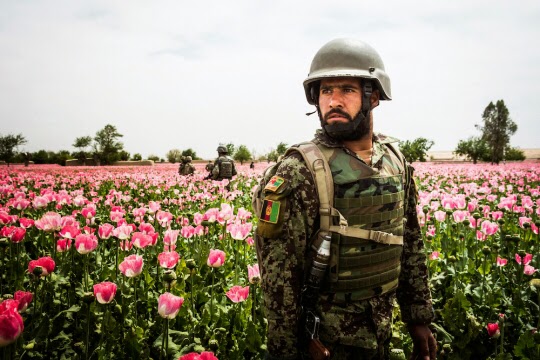
Surprise: U.S. drug war in Afghanistan not going well

A new report has found the war on drugs in Afghanistan remains colossally expensive, largely ineffective and likely to get worse. This is particularly true in the case of opium production, says the U.S. Office of the Special Inspector General for Afghanistan Reconstruction.

In a damning report released Tuesday, the special inspector general, Justin F. Sopko, writes that “despite spending over $7 billion to combat opium poppy cultivation and to develop the Afghan government’s counternarcotics capacity, opium poppy cultivation levels in Afghanistan hit an all-time high in 2013,” hitting 209,000 hectares, surpassing the prior, 2007 peak of 193,000 hectares. Sopko adds that the number should continue to rise thanks to deteriorating security in rural Afghanistan and weak eradication efforts.

Though the figures it reports are jarring, the inspector general’s investigation highlights drug policy failures in Afghanistan that have been consistently documented for years. Indeed, Sopko himself has been raising concerns over the failing drug war in Afghanistan for some time. In January, he testified before the Senate Caucus on International Narcotics Control and described a series of discouraging conversations with counternarcotics officials from Afghanistan, the U.S., and elsewhere.

“In the opinion of almost everyone I spoke with, the situation in Afghanistan is dire with little prospect for improvement in 2014 or beyond,” Sopko told the lawmakers. “All of the fragile gains we have made over the last 12 years on women’s issues, health, education, rule of law, and governance are now, more than ever, in jeopardy of being wiped out by the narcotics trade which not only supports the insurgency, but also feeds organized crime and corruption.”

While many of the numbers included in the inspector general’s investigation have been made public before, the report serves as a reminder that, in addition to contributing to more than 70,000 deaths in Mexico over eight years, the bloody destabilization of Central America, and the expansion of the largest prison population in history in the United States, the ongoing U.S. effort to eliminate the market for illicit drugs at home and abroad is failing. Afghanistan is still considered the number one producer of opium in the world, responsible for as much as 90 percent of the market, which in turn supports the global heroin trade, even if only a small percentage of heroin from Afghanistan is believed to reach the U.S.

By June of 2014, U.S. departments and agencies — including the Pentagon, the State Department, USAID, the Drug Enforcement Administration and others — had spent a total of $7.6 billion to fight drugs in Afghanistan. Specifically, Sopko notes, the U.S. tax dollars poured into Afghanistan have been intended to support “the development of Afghan government counternarcotics capacity, operational support to Afghan counternarcotics forces; encouragement of alternative livelihoods for Afghan farmers; financial incentives to Afghan authorities to enforce counternarcotics laws; and, in limited instances, counternarcotics operations conducted by U.S. authorities in coordination with their Afghan counterparts.” The results, the inspector general points out, have left something to be desired.

Sopko reports that the resurgence in Afghan poppy cultivation has been driven by the high price of the crop, cheap and mobile labor, and “[a]ffordable deep-well technology,” which “has turned 200,000 hectares of desert in southwestern Afghanistan into arable land over the past decade.” According to figures from the United Nations Office on Drugs and Crime, from 2012 to 2013 the value of opium and the products derived from it increased by 50 percent, from $2 billion to $3 billion.

While U.S. efforts have failed to effectively diminish drug trafficking in Afghanistan, they have succeeded in making a handful of private security companies increasingly rich, a point that is not addressed in the inspector general’s report. In 2009, official responsibility for training Afghan police forces was shifted from the State Department to an obscure branch of the Pentagon known as Counter Narco-Terrorism Program Office (CNTPO), which took over the roughly $1 billion contract. In waging the privatized war on drugs, CNTPO has partnered with such corporate security giants as Raytheon, Lockheed Martin, ARINC, DynCorp and U.S. Training Center, a subsidiary of the firm formerly known as Blackwater.

With the pullout of U.S. forces looming — special operations units notwithstanding — the future of Afghanistan looks grim. Experts at the Afghanistan Analysts Network have noted the expanding power of warlords in Afghanistan’s rural regions. Meanwhile, security agreements between the Afghan government and the U.S. and NATO forces have avoided reining in CIA-backed paramilitaries that have shouldered much of the United States’ dirty work in the last 13 years of war. The rising viability of the opium trade, and the corruption it so often invites, adds yet another layer of complexity to an already fragile situation.

In his report, Sopko encourages the U.S. government and its coalition partners to look back on the years of counternarcotics efforts in Afghanistan and consider what today’s record high levels of poppy cultivation might suggest.

“In past years, surges in opium poppy cultivation have been met by a coordinated response from the U.S. government and coalition partners, which has led to a temporary decline in levels of opium production,” he writes. “However, the recent record-high level of poppy cultivation calls into question the long- term effectiveness and sustainability of those prior efforts.” More


Tuesday, September 23, 2014

Peter Van Buren, Back to the Future in Iraq

On April 4, 1967, Martin Luther King delivered a speech at Riverside Church in New York City titled “Beyond Vietnam: A Time to Break Silence.” In it, he went after the war of that moment and the money that the U.S. was pouring into it as symptoms of a societal disaster.

President Lyndon Johnson’s poverty program was being “broken and eviscerated,” King said from the pulpit of that church, “as if it were some idle political plaything on a society gone mad on war... We were taking the black young men who had been crippled by our society and sending them eight thousand miles away to guarantee liberties in Southeast Asia which they had not found in southwest Georgia and East Harlem. I could not be silent in the face of such cruel manipulation of the poor.” Twice more in that ringing speech he spoke of “the madness of Vietnam” and called for it to cease.

Don’t think of that as just a preacher’s metaphor. There was a genuine madness on the loose -- and not just in the “free-fire zones” of Vietnam but in policy circles here in the United States, in the frustration of top military and civilian officials who felt gripped by an eerie helplessness as they widened a terrible war on the ground and in the air. They were, it seemed, incapable of imagining any other path than escalation in the face of disaster and possible defeat. Even in the years of Ronald Reagan’s presidency, when there was a brief attempt to paint that lost war in a more heroic hue (“a noble cause,” the president called it), that sense of madness, or at least of resulting mental illness, lingered. It remained embedded in a phrase then regularly applied to Americans who were less than willing to once again head aggressively into the world. They were suffering from, it was said, “Vietnam syndrome.”

Today, almost 25 years into what someday might simply be called America’s Iraq War (whose third iteration we’ve recently entered), you can feel that a similar “madness” has Washington by the throat. Just as King noted of the Vietnam era, since 9/11 American domestic programs and agencies have been starved while money poured into the coffers of the Pentagon and an increasingly bloated national security state. The results have been obvious. In the face of the spreading Ebola virus in West Africa, for instance, the president can no longer turn to civilian agencies or organizations for help, but has to call on the U.S. military in an “Ebola surge” -- even our language has been militarized -- although its forces are not known for their skills, successes, or spendthrift ways when it comes to civilian “humanitarian” or nation-building operations.

We’ve already entered the period when strategy, such as it is, falls away, and our leaders feel strangely helpless before the drip, drip, drip of failure and the unbearable urge for further escalation. At this point, in fact, the hysteria in Washington over the Islamic State seems a pitch or two higher than anything experienced in the Vietnam years. A fiercely sectarian force in the Middle East has captured the moment and riveted attention, even though its limits in a region full of potential enemies seem obvious and its “existential threat” to the U.S. consists of the possibility that some stray American jihadi might indeed try to harm a few of us. Call it emotional escalation in a Washington that seems remarkably unhinged.

It took Osama bin Laden $400,000 to $500,000, 19 hijackers, and much planning to produce the fallen towers of 9/11 and the ensuing hysteria in this country that launched the disastrous, never-ending Global War on Terror. It took the leaders of the Islamic State maybe a few hundred bucks and two grim videos, featuring three men on a featureless plain in Syria, to create utter, blind hysteria here. Think of this as confirmation of Karl Marx’s famous comment that the first time is tragedy, but the second is farce.

One clear sign of the farcical nature of our moment is the inability to use almost any common word or phrase in an uncontested way if you put "Iraq" or "Islamic State" or "Syria" in the same sentence. Remember when the worst Washington could come up with in contested words was the meaning of “is” in Bill Clinton’s infamous statement about his relationship with a White House intern? Linguistically speaking, those were the glory days, the utopian days of official Washington.

Just consider three commonplace terms of the moment: “war,” “boots on the ground,” and “combat.” A single question links them all: Are we or aren’t we? And to that, in each case, Washington has no acceptable answer. On war, the secretary of state said no, we weren’t; the White House and Pentagon press offices announced that yes, we were; and the president fudged. He called it “targeted action” and spoke of America’s “unique capability to mobilize against an organization like ISIL,” but God save us, what it wasn't and wouldn't be was a “ground war.”

Only with Congress did a certain clarity prevail. Nothing it did really mattered. Whatever Congress decided or refused to decide when it came to going to war would be fine and dandy, because the White House was going to do “it” anyway. “It,” of course, was the Clintonesque “is” of present-day Middle Eastern policy. Who knew what it was, but here was what it wasn’t and would never be: “boots on the ground.” Admittedly, the president has already dispatched 1,600 booted troops to Iraq’s ground (with more to come), but they evidently didn’t qualify as boots on the ground because, whatever they were doing, they would not be going into “combat” (which is evidently the only place where military boots officially hit the ground). The president has been utterly clear on this. There would be no American “combat mission” in Iraq. Unfortunately, “combat” turns out to be another of those dicey terms, since those non-boots had barely landed in Iraq when Chairman of the Joint Chiefs Martin Dempsey started to raise the possibility that some of them, armed, might one day be forward deployed with Iraqi troops as advisers and spotters for U.S. air power in future battles for Iraq’s northern cities. This, the White House now seems intent on defining as not being a “combat mission.”

And we’re only weeks into an ongoing operation that could last years. Imagine the pretzeling of the language by then. Perhaps it might be easiest if everyone -- Congress, the White House, the Pentagon, and Washington’s pundits -- simply agreed that the United States is at “war-ish” in Iraq, with boots on the ground-ish in potentially combat-ish situations. Former State Department whistleblower and TomDispatch regular Peter Van Buren spent his own time in Iraq and wrote We Meant Well: How I Helped Lose the Battle for the Hearts and Minds of the Iraqi People about it. Now, he considers the mind-boggling strangeness of Washington doing it all over again, this time as the grimmest of farces. Tom

Apocalypse Now, Iraq Edition
Fighting in Iraq Until Hell Freezes Over
By Peter Van Buren

I wanted to offer a wry chuckle before we headed into the heavy stuff about Iraq, so I tried to start this article with a suitably ironic formulation. You know, a déjà-vu-all-over-again kinda thing. I even thought about telling you how, in 2011, I contacted a noted author to blurb my book, We Meant Well: How I Helped Lose the Battle for the Hearts and Minds of the Iraqi People, and he presciently declined, saying sardonically, “So you're gonna be the one to write the last book on failure in Iraq?”

I couldn't do any of that. As someone who cares deeply about this country, I find it beyond belief that Washington has again plunged into the swamp of the Sunni-Shia mess in Iraq. A young soldier now deployed as one of the 1,600 non-boots-on-the-ground there might have been eight years old when the 2003 invasion took place. He probably had to ask his dad about it. After all, less than three years ago, when dad finally came home with his head “held high,” President Obama assuredAmericans that “we’re leaving behind a sovereign, stable and self-reliant Iraq.” So what happened in the blink of an eye?

The Sons of Iraq

Sometimes, when I turn on the TV these days, the sense of seeing once again places in Iraq I'd been overwhelms me. After 22 years as a diplomat with the Department of State, I spent 12 long months in Iraq in 2009-2010 as part of the American occupation. My role was to lead two teams in “reconstructing” the nation. In practice, that meant paying for schools that would never be completed, setting up pastry shops on streets without water or electricity, and conducting endless propaganda events on Washington-generated themes of the week (“small business,” “women's empowerment,” “democracy building.”)

We even organized awkward soccer matches, where American taxpayer money was used to coerce reluctant Sunni teams into facing off against hesitant Shia ones in hopes that, somehow, the chaos created by the American invasion could be ameliorated on the playing field. In an afternoon, we definitively failed to reconcile the millennium-old Sunni-Shia divide we had sparked into ethnic-cleansing-style life in 2003-2004, even if the score was carefully stage managed into a tie by the 82nd Airborne soldiers with whom I worked.

In 2006, the U.S. brokered the ascension to power of Prime Minister Nouri al-Maliki, a Shia politician handpicked to unite Iraq. A bright, shining lie of a plan soon followed. Applying vast amounts of money, Washington’s emissaries created the Sahwa, or Sons of Iraq, a loose grouping of Sunnis anointed as “moderates” who agreed to temporarily stop killing in return for a promised place at the table in the New(er) Iraq. The “political space” for this was to be created by a massive escalation of the American military effort, which gained a particularly marketable name: the surge.

I was charged with meeting the Sahwa leaders in my area. My job back then was to try to persuade them to stay on board just a little longer, even as they came to realize that they'd been had. Maliki’s Shia government in Baghdad, which was already ignoring American entreaties to be inclusive, was hell-bent on ensuring that there would be no Sunni “sons” in its Iraq.

False alliances and double-crosses were not unfamiliar to the Sunni warlords I engaged with. Often, our talk -- over endless tiny glasses of sweet, sweet tea stirred with white-hot metal spoons -- shifted from the Shia and the Americans to their great-grandfathers' struggle against the British. Revenge unfolds over generations, they assured me, and memories are long in the Middle East, they warned.

When I left in 2010, the year before the American military finally departed, the truth on the ground should have been clear enough to anyone with the vision to take it in. Iraq had already been tacitly divided into feuding state-lets controlled by Sunnis, Shias, and Kurds. The Baghdad government had turned into a typical, gleeful third-world kleptocracy fueled by American money, but with a particularly nasty twist: they were also a group of autocrats dedicated to persecuting, marginalizing, degrading, and perhaps one day destroying the country’s Sunni minority.

U.S. influence was fading fast, leaving the State Department, a small military contingent, various spooks, and contractors hidden behind the walls of the billion-dollar embassy (the largest in the world!) that had been built in a moment of imperial hubris. The foreign power with the most influence over events was by then Iran, the country the Bush administration had once been determined to take down alongside Saddam Hussein as part of the Axis of Evil.

The Grandsons of Iraq

The staggering costs of all this -- $25 billion to train the Iraqi Army, $60 billion for the reconstruction-that-wasn’t, $2 trillion for the overall war, almost 4,500 Americans dead and more than 32,000 wounded, and an Iraqi death toll of more than190,000 (though some estimates go as high as a million) -- can now be measured against the results. The nine-year attempt to create an American client state in Iraq failed, tragically and completely. The proof of that is on today's front pages. More