Monday, October 27, 2014

Surprise: U.S. drug war in Afghanistan not going well

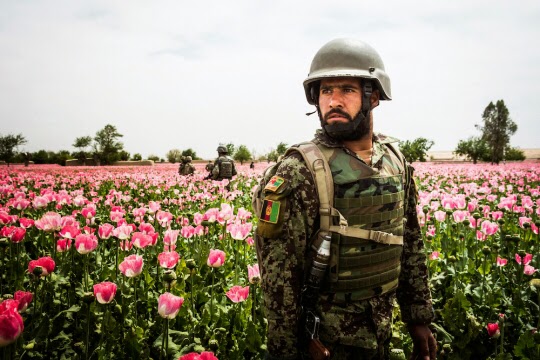
A new report has found the war on drugs in Afghanistan remains colossally expensive, largely ineffective and likely to get worse. This is particularly true in the case of opium production, says the U.S. Office of the Special Inspector General for Afghanistan Reconstruction.

In a damning report released Tuesday, the special inspector general, Justin F. Sopko, writes that “despite spending over $7 billion to combat opium poppy cultivation and to develop the Afghan government’s counternarcotics capacity, opium poppy cultivation levels in Afghanistan hit an all-time high in 2013,” hitting 209,000 hectares, surpassing the prior, 2007 peak of 193,000 hectares. Sopko adds that the number should continue to rise thanks to deteriorating security in rural Afghanistan and weak eradication efforts.

Though the figures it reports are jarring, the inspector general’s investigation highlights drug policy failures in Afghanistan that have been consistently documented for years. Indeed, Sopko himself has been raising concerns over the failing drug war in Afghanistan for some time. In January, he testified before the Senate Caucus on International Narcotics Control and described a series of discouraging conversations with counternarcotics officials from Afghanistan, the U.S., and elsewhere.

“In the opinion of almost everyone I spoke with, the situation in Afghanistan is dire with little prospect for improvement in 2014 or beyond,” Sopko told the lawmakers. “All of the fragile gains we have made over the last 12 years on women’s issues, health, education, rule of law, and governance are now, more than ever, in jeopardy of being wiped out by the narcotics trade which not only supports the insurgency, but also feeds organized crime and corruption.”

While many of the numbers included in the inspector general’s investigation have been made public before, the report serves as a reminder that, in addition to contributing to more than 70,000 deaths in Mexico over eight years, the bloody destabilization of Central America, and the expansion of the largest prison population in history in the United States, the ongoing U.S. effort to eliminate the market for illicit drugs at home and abroad is failing. Afghanistan is still considered the number one producer of opium in the world, responsible for as much as 90 percent of the market, which in turn supports the global heroin trade, even if only a small percentage of heroin from Afghanistan is believed to reach the U.S.

By June of 2014, U.S. departments and agencies — including the Pentagon, the State Department, USAID, the Drug Enforcement Administration and others — had spent a total of $7.6 billion to fight drugs in Afghanistan. Specifically, Sopko notes, the U.S. tax dollars poured into Afghanistan have been intended to support “the development of Afghan government counternarcotics capacity, operational support to Afghan counternarcotics forces; encouragement of alternative livelihoods for Afghan farmers; financial incentives to Afghan authorities to enforce counternarcotics laws; and, in limited instances, counternarcotics operations conducted by U.S. authorities in coordination with their Afghan counterparts.” The results, the inspector general points out, have left something to be desired.

Sopko reports that the resurgence in Afghan poppy cultivation has been driven by the high price of the crop, cheap and mobile labor, and “[a]ffordable deep-well technology,” which “has turned 200,000 hectares of desert in southwestern Afghanistan into arable land over the past decade.” According to figures from the United Nations Office on Drugs and Crime, from 2012 to 2013 the value of opium and the products derived from it increased by 50 percent, from $2 billion to $3 billion.

While U.S. efforts have failed to effectively diminish drug trafficking in Afghanistan, they have succeeded in making a handful of private security companies increasingly rich, a point that is not addressed in the inspector general’s report. In 2009, official responsibility for training Afghan police forces was shifted from the State Department to an obscure branch of the Pentagon known as Counter Narco-Terrorism Program Office (CNTPO), which took over the roughly $1 billion contract. In waging the privatized war on drugs, CNTPO has partnered with such corporate security giants as Raytheon, Lockheed Martin, ARINC, DynCorp and U.S. Training Center, a subsidiary of the firm formerly known as Blackwater.

With the pullout of U.S. forces looming — special operations units notwithstanding — the future of Afghanistan looks grim. Experts at the Afghanistan Analysts Network have noted the expanding power of warlords in Afghanistan’s rural regions. Meanwhile, security agreements between the Afghan government and the U.S. and NATO forces have avoided reining in CIA-backed paramilitaries that have shouldered much of the United States’ dirty work in the last 13 years of war. The rising viability of the opium trade, and the corruption it so often invites, adds yet another layer of complexity to an already fragile situation.

In his report, Sopko encourages the U.S. government and its coalition partners to look back on the years of counternarcotics efforts in Afghanistan and consider what today’s record high levels of poppy cultivation might suggest.

“In past years, surges in opium poppy cultivation have been met by a coordinated response from the U.S. government and coalition partners, which has led to a temporary decline in levels of opium production,” he writes. “However, the recent record-high level of poppy cultivation calls into question the long- term effectiveness and sustainability of those prior efforts.” More


Tuesday, September 23, 2014

Peter Van Buren, Back to the Future in Iraq

On April 4, 1967, Martin Luther King delivered a speech at Riverside Church in New York City titled “Beyond Vietnam: A Time to Break Silence.” In it, he went after the war of that moment and the money that the U.S. was pouring into it as symptoms of a societal disaster.

President Lyndon Johnson’s poverty program was being “broken and eviscerated,” King said from the pulpit of that church, “as if it were some idle political plaything on a society gone mad on war... We were taking the black young men who had been crippled by our society and sending them eight thousand miles away to guarantee liberties in Southeast Asia which they had not found in southwest Georgia and East Harlem. I could not be silent in the face of such cruel manipulation of the poor.” Twice more in that ringing speech he spoke of “the madness of Vietnam” and called for it to cease.

Don’t think of that as just a preacher’s metaphor. There was a genuine madness on the loose -- and not just in the “free-fire zones” of Vietnam but in policy circles here in the United States, in the frustration of top military and civilian officials who felt gripped by an eerie helplessness as they widened a terrible war on the ground and in the air. They were, it seemed, incapable of imagining any other path than escalation in the face of disaster and possible defeat. Even in the years of Ronald Reagan’s presidency, when there was a brief attempt to paint that lost war in a more heroic hue (“a noble cause,” the president called it), that sense of madness, or at least of resulting mental illness, lingered. It remained embedded in a phrase then regularly applied to Americans who were less than willing to once again head aggressively into the world. They were suffering from, it was said, “Vietnam syndrome.”

Today, almost 25 years into what someday might simply be called America’s Iraq War (whose third iteration we’ve recently entered), you can feel that a similar “madness” has Washington by the throat. Just as King noted of the Vietnam era, since 9/11 American domestic programs and agencies have been starved while money poured into the coffers of the Pentagon and an increasingly bloated national security state. The results have been obvious. In the face of the spreading Ebola virus in West Africa, for instance, the president can no longer turn to civilian agencies or organizations for help, but has to call on the U.S. military in an “Ebola surge” -- even our language has been militarized -- although its forces are not known for their skills, successes, or spendthrift ways when it comes to civilian “humanitarian” or nation-building operations.

We’ve already entered the period when strategy, such as it is, falls away, and our leaders feel strangely helpless before the drip, drip, drip of failure and the unbearable urge for further escalation. At this point, in fact, the hysteria in Washington over the Islamic State seems a pitch or two higher than anything experienced in the Vietnam years. A fiercely sectarian force in the Middle East has captured the moment and riveted attention, even though its limits in a region full of potential enemies seem obvious and its “existential threat” to the U.S. consists of the possibility that some stray American jihadi might indeed try to harm a few of us. Call it emotional escalation in a Washington that seems remarkably unhinged.

It took Osama bin Laden $400,000 to $500,000, 19 hijackers, and much planning to produce the fallen towers of 9/11 and the ensuing hysteria in this country that launched the disastrous, never-ending Global War on Terror. It took the leaders of the Islamic State maybe a few hundred bucks and two grim videos, featuring three men on a featureless plain in Syria, to create utter, blind hysteria here. Think of this as confirmation of Karl Marx’s famous comment that the first time is tragedy, but the second is farce.

One clear sign of the farcical nature of our moment is the inability to use almost any common word or phrase in an uncontested way if you put "Iraq" or "Islamic State" or "Syria" in the same sentence. Remember when the worst Washington could come up with in contested words was the meaning of “is” in Bill Clinton’s infamous statement about his relationship with a White House intern? Linguistically speaking, those were the glory days, the utopian days of official Washington.

Just consider three commonplace terms of the moment: “war,” “boots on the ground,” and “combat.” A single question links them all: Are we or aren’t we? And to that, in each case, Washington has no acceptable answer. On war, the secretary of state said no, we weren’t; the White House and Pentagon press offices announced that yes, we were; and the president fudged. He called it “targeted action” and spoke of America’s “unique capability to mobilize against an organization like ISIL,” but God save us, what it wasn't and wouldn't be was a “ground war.”

Only with Congress did a certain clarity prevail. Nothing it did really mattered. Whatever Congress decided or refused to decide when it came to going to war would be fine and dandy, because the White House was going to do “it” anyway. “It,” of course, was the Clintonesque “is” of present-day Middle Eastern policy. Who knew what it was, but here was what it wasn’t and would never be: “boots on the ground.” Admittedly, the president has already dispatched 1,600 booted troops to Iraq’s ground (with more to come), but they evidently didn’t qualify as boots on the ground because, whatever they were doing, they would not be going into “combat” (which is evidently the only place where military boots officially hit the ground). The president has been utterly clear on this. There would be no American “combat mission” in Iraq. Unfortunately, “combat” turns out to be another of those dicey terms, since those non-boots had barely landed in Iraq when Chairman of the Joint Chiefs Martin Dempsey started to raise the possibility that some of them, armed, might one day be forward deployed with Iraqi troops as advisers and spotters for U.S. air power in future battles for Iraq’s northern cities. This, the White House now seems intent on defining as not being a “combat mission.”

And we’re only weeks into an ongoing operation that could last years. Imagine the pretzeling of the language by then. Perhaps it might be easiest if everyone -- Congress, the White House, the Pentagon, and Washington’s pundits -- simply agreed that the United States is at “war-ish” in Iraq, with boots on the ground-ish in potentially combat-ish situations. Former State Department whistleblower and TomDispatch regular Peter Van Buren spent his own time in Iraq and wrote We Meant Well: How I Helped Lose the Battle for the Hearts and Minds of the Iraqi People about it. Now, he considers the mind-boggling strangeness of Washington doing it all over again, this time as the grimmest of farces. Tom

Apocalypse Now, Iraq Edition
Fighting in Iraq Until Hell Freezes Over
By Peter Van Buren

I wanted to offer a wry chuckle before we headed into the heavy stuff about Iraq, so I tried to start this article with a suitably ironic formulation. You know, a déjà-vu-all-over-again kinda thing. I even thought about telling you how, in 2011, I contacted a noted author to blurb my book, We Meant Well: How I Helped Lose the Battle for the Hearts and Minds of the Iraqi People, and he presciently declined, saying sardonically, “So you're gonna be the one to write the last book on failure in Iraq?”

I couldn't do any of that. As someone who cares deeply about this country, I find it beyond belief that Washington has again plunged into the swamp of the Sunni-Shia mess in Iraq. A young soldier now deployed as one of the 1,600 non-boots-on-the-ground there might have been eight years old when the 2003 invasion took place. He probably had to ask his dad about it. After all, less than three years ago, when dad finally came home with his head “held high,” President Obama assuredAmericans that “we’re leaving behind a sovereign, stable and self-reliant Iraq.” So what happened in the blink of an eye?

The Sons of Iraq

Sometimes, when I turn on the TV these days, the sense of seeing once again places in Iraq I'd been overwhelms me. After 22 years as a diplomat with the Department of State, I spent 12 long months in Iraq in 2009-2010 as part of the American occupation. My role was to lead two teams in “reconstructing” the nation. In practice, that meant paying for schools that would never be completed, setting up pastry shops on streets without water or electricity, and conducting endless propaganda events on Washington-generated themes of the week (“small business,” “women's empowerment,” “democracy building.”)

We even organized awkward soccer matches, where American taxpayer money was used to coerce reluctant Sunni teams into facing off against hesitant Shia ones in hopes that, somehow, the chaos created by the American invasion could be ameliorated on the playing field. In an afternoon, we definitively failed to reconcile the millennium-old Sunni-Shia divide we had sparked into ethnic-cleansing-style life in 2003-2004, even if the score was carefully stage managed into a tie by the 82nd Airborne soldiers with whom I worked.

In 2006, the U.S. brokered the ascension to power of Prime Minister Nouri al-Maliki, a Shia politician handpicked to unite Iraq. A bright, shining lie of a plan soon followed. Applying vast amounts of money, Washington’s emissaries created the Sahwa, or Sons of Iraq, a loose grouping of Sunnis anointed as “moderates” who agreed to temporarily stop killing in return for a promised place at the table in the New(er) Iraq. The “political space” for this was to be created by a massive escalation of the American military effort, which gained a particularly marketable name: the surge.

I was charged with meeting the Sahwa leaders in my area. My job back then was to try to persuade them to stay on board just a little longer, even as they came to realize that they'd been had. Maliki’s Shia government in Baghdad, which was already ignoring American entreaties to be inclusive, was hell-bent on ensuring that there would be no Sunni “sons” in its Iraq.

False alliances and double-crosses were not unfamiliar to the Sunni warlords I engaged with. Often, our talk -- over endless tiny glasses of sweet, sweet tea stirred with white-hot metal spoons -- shifted from the Shia and the Americans to their great-grandfathers' struggle against the British. Revenge unfolds over generations, they assured me, and memories are long in the Middle East, they warned.

When I left in 2010, the year before the American military finally departed, the truth on the ground should have been clear enough to anyone with the vision to take it in. Iraq had already been tacitly divided into feuding state-lets controlled by Sunnis, Shias, and Kurds. The Baghdad government had turned into a typical, gleeful third-world kleptocracy fueled by American money, but with a particularly nasty twist: they were also a group of autocrats dedicated to persecuting, marginalizing, degrading, and perhaps one day destroying the country’s Sunni minority.

U.S. influence was fading fast, leaving the State Department, a small military contingent, various spooks, and contractors hidden behind the walls of the billion-dollar embassy (the largest in the world!) that had been built in a moment of imperial hubris. The foreign power with the most influence over events was by then Iran, the country the Bush administration had once been determined to take down alongside Saddam Hussein as part of the Axis of Evil.

The Grandsons of Iraq

The staggering costs of all this -- $25 billion to train the Iraqi Army, $60 billion for the reconstruction-that-wasn’t, $2 trillion for the overall war, almost 4,500 Americans dead and more than 32,000 wounded, and an Iraqi death toll of more than190,000 (though some estimates go as high as a million) -- can now be measured against the results. The nine-year attempt to create an American client state in Iraq failed, tragically and completely. The proof of that is on today's front pages. More


Friday, August 22, 2014

When fear changed sides - Quand la peur change de camp

Thoughts on the Arab revolutions - Réflexions sur les révolutions arabes...

The organization abbreviated as ISIS (Islamic State in Iraq and Syria) is not new in the region, nor is it a newfound expression of the crises afflicting Arab societies at a moment of profound transformations, initiated by 2011 revolutions.

To the contrary, ISIS is the offspring of more than one father, and the product of more than one longstanding and widespread sickness. The organization’s explosive growth today is in fact the result of previously existing, worsening conflicts that were caused by the different fathers.

ISIS is first the child of despotism in the most heinous form that has plagued the region. Therefore, it is no coincidence that we see its base, its source of strength concentrated in Iraq and Syria, where Saddam Hussein and Hafez and Bashar Al-Assad reigned for decades, killing hundreds of thousands of people, destroying political life, and deepening sectarianism by transforming it into a mechanism of exclusion and polarization, to the point that injustices and crimes against humanity became commonplace.

ISIS is second the progeny of the American invasion of Iraq in 2003, both the way in which it was initially conducted and the catastrophic mismanagement that followed. Specifically, it was the exclusion of a wide swath of Iraqis from post invasion political processes and the formation of a new authority that discriminated against them and held them collectively at fault for the guilt of Saddam and his party, which together enabled groups (such as those first established by Abu Musab al-Zarqawi) whose activities have been resumed by ISIS to get in touch with some parts of Iraqi society and to establish itself among them.

ISIS is third the son of Iranian aggressive regional policies that have worsened in recent years — taking Iraq, Lebanon, and Syria as its backyard, feeding (directly or indirectly) confessional divisions and making these divides the backbone of ideological mobilization and a policy of revenge and retaliation that has constructed a destructive feedback loop.

ISIS is fourth the child of some of the Salafist networks in the Gulf (in Saudi Arabia and other states), which emerged and developed throughout the 1980s, following the oil boom and the "Afghan jihad". These networks have continued to operate and expand throughout the last two decades under various names, all in the interest of extremism and obscurantism.

ISIS is fifth the offspring of a profound crisis, deeply rooted in the thinking of some Islamist groups seeking to escape from their terrible failure to confront the challenges of the present toward a delusional model ostensibly taken from the seventh century, believing that they have found within its imaginary folds the answer to all contemporary or future questions.

ISIS is sixth the progeny of violence, or of an environment that has been subjected to striking brutality, which has allowed the growth of this disease and facilitated the emergence of what could be called "ISISism". Like Iraq previously, Syria today has been abandoned beneath explosive barrels to become a laboratory, a testing ground for violence, daily massacres and their outcomes.

ISIS, an abominable, savage creature, is thus the product of at least these six fathers. Its persistency depends on the continuation of these aforementioned elements, particularly the element of violence embodied by the Assad regime in Syria. Those who think that they should be impartial toward or even support tyrants like Assad in the fight against ISISism fail to realize that his regime is in fact at the root of the problem.

Until this fact is recognized — that despotism is the disease and not the cure — we can only expect more deadly repercussions, from the Middle East to the distant corners of the globe… More


Wednesday, August 20, 2014

Beware, fellow plutocrats, the pitchforks are coming

Nick Hanauer: Beware, fellow plutocrats, the pitchforks are coming


Published on Aug 12, 2014 • Nick Hanauer is a rich guy, an unrepentant capitalist — and he has something to say to his fellow plutocrats: Wake up! Growing inequality is about to push our societies into conditions resembling prerevolutionary France. Hear his argument about why a dramatic increase in minimum wage could grow the middle class, deliver economic prosperity ... and prevent a revolution.

TEDTalks is a daily video podcast of the best talks and performances from the TED Conference, where the world's leading thinkers and doers give the talk of their lives in 18 minutes (or less). Look for talks on Technology, Entertainment and Design - plus science, business, global issues, the arts and much more.

Find closed captions and translated subtitles in many languages at http://www.ted.com/translate

Follow TED news on Twitter: http://www.twitter.com/tednews

Like TED on Facebook: https ://www.facebook.com/TE D

Subscribe to our channel: http://www.youtube.com/user/TEDtalksDirector

Saturday, June 21, 2014

Pentagon preparing for mass civil breakdown

A US Department of Defense (DoD) research programme is funding universities to model the dynamics, risks and tipping points for large-scale civil unrest across the world, under the supervision of various US military agencies.

The multi-million dollar programme is designed to develop immediate and long-term "warfighter-relevant insights" for senior officials and decision makers in "the defense policy community," and to inform policy implemented by "combatant commands."

Launched in 2008 – the year of the global banking crisis – the DoD 'Minerva Research Initiative' partners with universities "to improve DoD's basic understanding of the social, cultural, behavioral, and political forces that shape regions of the world of strategic importance to the US."

Among the projects awarded for the period 2014-2017 is a Cornell University-led study managed by the US Air Force Office of Scientific Research which aims to develop an empirical model "of the dynamics of social movement mobilisation and contagions." The project will determine "the critical mass (tipping point)" of social contagians by studying their "digital traces" in the cases of "the 2011 Egyptian revolution, the 2011 Russian Duma elections, the 2012 Nigerian fuel subsidy crisis and the 2013 Gazi park protests in Turkey."

Twitter posts and conversations will be examined "to identify individuals mobilised in a social contagion and when they become mobilised."

Another project awarded this year to the University of Washington "seeks to uncover the conditions under which political movements aimed at large-scale political and economic change originate," along with their "characteristics and consequences." The project, managed by the US Army Research Office, focuses on "large-scale movements involving more than 1,000 participants in enduring activity," and will cover 58 countries in total.

Last year, the DoD's Minerva Initiative funded a project to determine 'Who Does Not Become a Terrorist, and Why?' which, however, conflates peaceful activists with "supporters of political violence" who are different from terrorists only in that they do not embark on "armed militancy" themselves. The project explicitly sets out to study non-violent activists:

"In every context we find many individuals who share the demographic, family, cultural, and/or socioeconomic background of those who decided to engage in terrorism, and yet refrained themselves from taking up armed militancy, even though they were sympathetic to the end goals of armed groups. The field of terrorism studies has not, until recently, attempted to look at this control group. This project is not about terrorists, but about supporters of political violence."

The project's 14 case studies each "involve extensive interviews with ten or more activists and militants in parties and NGOs who, though sympathetic to radical causes, have chosen a path of non-violence."

I contacted the project's principal investigator, Prof Maria Rasmussen of the US Naval Postgraduate School, asking why non-violent activists working for NGOs should be equated to supporters of political violence – and which "parties and NGOs" were being investigated – but received no response.

Similarly, Minerva programme staff refused to answer a series of similar questions I put to them, including asking how "radical causes" promoted by peaceful NGOs constituted a potential national security threat of interest to the DoD.

Among my questions, I asked:

"Does the US Department of Defense see protest movements and social activism in different parts of the world as a threat to US national security? If so, why? Does the US Department of Defense consider political movements aiming for large scale political and economic change as a national security matter? If so, why? Activism, protest, 'political movements' and of course NGOs are a vital element of a healthy civil society and democracy - why is it that the DoD is funding research to investigate such issues?"

Minerva's programme director Dr Erin Fitzgerald said "I appreciate your concerns and am glad that you reached out to give us the opportunity to clarify" before promising a more detailed response. Instead, I received the following bland statement from the DoD's press office:

"The Department of Defense takes seriously its role in the security of the United States, its citizens, and US allies and partners. While every security challenge does not cause conflict, and every conflict does not involve the US military, Minerva helps fund basic social science research that helps increase the Department of Defense's understanding of what causes instability and insecurity around the world. By better understanding these conflicts and their causes beforehand, the Department of Defense can better prepare for the dynamic future security environment."

In 2013, Minerva funded a University of Maryland project in collaboration with the US Department of Energy's Pacific Northwest National Laboratory to gauge the risk of civil unrest due to climate change. The three-year $1.9 million project is developing models to anticipate what could happen to societies under a range of potential climate change scenarios.

From the outset, the Minerva programme was slated to provide over $75 million over five years for social and behavioural science research. This year alone it has been allocated a total budget of $17.8 million by US Congress.

An internal Minerva staff email communication referenced in a 2012 Masters dissertation reveals that the programme is geared toward producing quick results that are directly applicable to field operations. The dissertation was part of a Minerva-funded project on "counter-radical Muslim discourse" at Arizona State University.

The internal email from Prof Steve Corman, a principal investigator for the project, describes a meeting hosted by the DoD's Human Social Cultural and Behavioural Modeling (HSCB) programme in which senior Pentagon officials said their priority was "to develop capabilities that are deliverable quickly" in the form of "models and tools that can be integrated with operations."

Although Office of Naval Research supervisor Dr Harold Hawkins had assured the university researchers at the outset that the project was merely "a basic research effort, so we shouldn't be concerned about doing applied stuff", the meeting in fact showed that DoD is looking to "feed results" into "applications," Corman said in the email. He advised his researchers to "think about shaping results, reports, etc., so they [DoD] can clearly see their application for tools that can be taken to the field."

Many independent scholars are critical of what they see as the US government's efforts to militarise social science in the service of war. In May 2008, the American Anthropological Association (AAA) wrote to the US government noting that the Pentagon lacks "the kind of infrastructure for evaluating anthropological [and other social science] research" in a way that involves "rigorous, balanced and objective peer review", calling for such research to be managed instead by civilian agencies like the National Science Foundation (NSF).

The following month, the DoD signed a memorandum of understanding (MoU) with the NSF to cooperate on the management of Minerva. In response, the AAA cautioned that although research proposals would now be evaluated by NSF's merit-review panels. "Pentagon officials will have decision-making power in deciding who sits on the panels":

"… there remain concerns within the discipline that research will only be funded when it supports the Pentagon's agenda. Other critics of the programme, including the Network of Concerned Anthropologists, have raised concerns that the programme would discourage research in other important areas and undermine the role of the university as a place for independent discussion and critique of the military."

According to Prof David Price, a cultural anthropologist at St Martin's University in Washington DC and author of Weaponizing Anthropology: Social Science in Service of the Militarized State, "when you looked at the individual bits of many of these projects they sort of looked like normal social science, textual analysis, historical research, and so on, but when you added these bits up they all shared themes of legibility with all the distortions of over-simplification. Minerva is farming out the piece-work of empire in ways that can allow individuals to disassociate their individual contributions from the larger project."

Prof Price has previously exposed how the Pentagon's Human Terrain Systems (HTS) programme - designed to embed social scientists in military field operations - routinely conducted training scenarios set in regions "within the United States."

Citing a summary critique of the programme sent to HTS directors by a former employee, Price reported that the HTS training scenarios "adapted COIN [counterinsurgency] for Afghanistan/Iraq" to domestic situations "in the USA where the local population was seen from the military perspective as threatening the established balance of power and influence, and challenging law and order."

One war-game, said Price, involved environmental activists protesting pollution from a coal-fired plant near Missouri, some of whom were members of the well-known environmental NGO Sierra Club. Participants were tasked to "identify those who were 'problem-solvers' and those who were 'problem-causers,' and the rest of the population whom would be the target of the information operations to move their Center of Gravity toward that set of viewpoints and values which was the 'desired end-state' of the military's strategy."

Such war-games are consistent with a raft of Pentagon planning documents which suggest that National Security Agency (NSA) mass surveillance is partially motivated to prepare for the destabilising impact of coming environmental, energy and economic shocks.

James Petras, Bartle Professor of Sociology at Binghamton University in New York, concurs with Price's concerns. Minerva-funded social scientists tied to Pentagon counterinsurgency operations are involved in the "study of emotions in stoking or quelling ideologically driven movements," he said, including how "to counteract grassroots movements."

Minerva is a prime example of the deeply narrow-minded and self-defeating nature of military ideology. Worse still, the unwillingness of DoD officials to answer the most basic questions is symptomatic of a simple fact – in their unswerving mission to defend an increasingly unpopular global system serving the interests of a tiny minority, security agencies have no qualms about painting the rest of us as potential terrorists. More


Friday, June 20, 2014

The open source revolution is coming and it will conquer the 1% - ex CIA spy

Robert David Steele, former Marine, CIA case officer, and US co-founder of the US Marine Corps intelligence activity, is a man on a mission. But it's a mission that frightens the US intelligence establishment to its core.


With 18 years experience working across the US intelligence community, followed by 20 more years in commercial intelligence and training, Steele's exemplary career has spanned almost all areas of both the clandestine world.

Steele started off as a Marine Corps infantry and intelligence officer. After four years on active duty, he joined the CIA for about a decade before co-founding the Marine Corps Intelligence Activity, where he was deputy director. Widely recognised as the leader of the Open Source Intelligence (OSINT) paradigm, Steele went on to write the handbooks on OSINT for NATO, the US Defense Intelligence Agency and the U.S. Special Operations Forces. In passing, he personally trained 7,500 officers from over 66 countries.

In 1992, despite opposition from the CIA, he obtained Marine Corps permission to organise a landmark international conference on open source intelligence – the paradigm of deriving information to support policy decisions not through secret activities, but from open public sources available to all. The conference was such a success it brought in over 620 attendees from the intelligence world.

But the CIA wasn't happy, and ensured that Steele was prohibited from running a second conference. The clash prompted him to resign from his position as second-ranking civilian in Marine Corps intelligence, and pursue the open source paradigm elsewhere. He went on to found and head up the Open Source Solutions Network Inc. and later the non-profit Earth Intelligence Network which runs the Public Intelligence Blog.

I first came across Steele when I discovered his Amazon review of my third book, The War on Truth: 9/11, Disinformation and the Anatomy of Terrorism. A voracious reader, Steele is the number 1 Amazon reviewer for non-fiction across 98 categories. He also reviewed my latest book, A User's Guide to the Crisis of Civilization, but told me I'd overlooked an important early work – 'A More Secure World: Our Shared Responsibility, Report of the UN High-Level Panel on Threats, Challenges, and Change.'

Last month, Steele presented a startling paper at the Libtech conference in New York, sponsored by the Internet Society and Reclaim. Drawing on principles set out in his latest book, The Open-Source Everything Manifesto: Transparency, Truth and Trust, he told the audience that all the major preconditions for revolution – set out in his 1976 graduate thesis – were now present in the United States and Britain.

Steele's book is a must-read, a powerful yet still pragmatic roadmap to a new civilisational paradigm that simultaneously offers a trenchant, unrelenting critique of the prevailing global order. His interdisciplinary 'whole systems' approach dramatically connects up the increasing corruption, inefficiency and unaccountability of the intelligence system and its political and financial masters with escalating inequalities and environmental crises. But he also offers a comprehensive vision of hope that activist networks like Reclaim are implementing today.

"We are at the end of a five-thousand-year-plus historical process during which human society grew in scale while it abandoned the early indigenous wisdom councils and communal decision-making," he writes in The Open Source Everything Manifesto. "Power was centralised in the hands of increasingly specialised 'elites' and 'experts' who not only failed to achieve all they promised but used secrecy and the control of information to deceive the public into allowing them to retain power over community resources that they ultimately looted."

Today's capitalism, he argues, is inherently predatory and destructive:

"Over the course of the last centuries, the commons was fenced, and everything from agriculture to water was commoditised without regard to the true cost in non-renewable resources. Human beings, who had spent centuries evolving away from slavery, were re-commoditised by the Industrial Era."

Open source everything, in this context, offers us the chance to build on what we've learned through industrialisation, to learn from our mistakes, and catalyse the re-opening of the commons, in the process breaking the grip of defunct power structures and enabling the possibility of prosperity for all.

"Sharing, not secrecy, is the means by which we realise such a lofty destiny as well as create infinite wealth. The wealth of networks, the wealth of knowledge, revolutionary wealth - all can create a nonzero win-win Earth that works for one hundred percent of humanity. This is the 'utopia' that Buckminster Fuller foresaw, now within our reach."

The goal, he concludes, is to reject:


"... concentrated illicitly aggregated and largely phantom wealth in favor of community wealth defined by community knowledge, community sharing of information, and community definition of truth derived in transparency and authenticity, the latter being the ultimate arbiter of shared wealth."

Despite this unabashedly radical vision, Steele is hugely respected by senior military intelligence experts across the world. As a researcher at the US Army War College's Strategic Studies Institute, he has authored several monographs advocating the need for open source methods to transform the craft of intelligence. He has lectured to the US State Department and Department of Homeland Security as well as National Security Councils in various countries, and his new book has received accolades from senior intelligence officials across multiple countries including France and Turkey.

Yet he remains an outspoken critic of US intelligence practices and what he sees as their integral role in aggravating rather than ameliorating the world's greatest threats and challenges.

This week, I had the good fortune of being able to touch base with Steele to dig deeper into his recent analysis of the future of US politics in the context of our accelerating environmental challenges. The first thing I asked him was where he sees things going over the next decade, given his holistic take.

"Properly educated people always appreciate holistic approaches to any challenge. This means that they understand both cause and effect, and intertwined complexities," he said. "A major part of our problem in the public policy arena is the decline in intelligence with integrity among key politicians and staff at the same time that think tanks and universities and non-governmental organisations have also suffered a similar intellectual diminishment.

"My early graduate education was in the 1970's when Limits to Growth and World Federalism were the rage. Both sought to achieve an over-view of systemic challenges, but both also suffered from the myth of top-down hubris. What was clear in the 1970s, that has been obscured by political and financial treason in the past half-century, is that everything is connected – what we do in the way of paving over wetlands, or in poisoning ground water 'inadvertently' because of our reliance on pesticides and fertilisers that are not subject to the integrity of the 'Precautionary Principle,' ultimately leads to climate catastrophes that are acts of man, not acts of god."

He points me to his tremendous collection of reviews of books on climate change, disease, environmental degradation, peak oil, and water scarcity. "I see five major overlapping threats on the immediate horizon," he continues. "They are all related: the collapse of complex societies, the acceleration of the Earth's demise with changes that used to take 10,000 years now taking three or less, predatory or shock capitalism and financial crime out of the City of London and Wall Street, and political corruption at scale, to include the west supporting 42 of 44 dictators. We are close to multiple mass catastrophes."

What about the claim that the US is on the brink of revolution? "Revolution is overthrow – the complete reversal of the status quo ante. We are at the end of centuries of what Lionel Tiger calls 'The Manufacture of Evil,' in which merchant banks led by the City of London have conspired with captive governments to concentrate wealth and commoditise everything including humans. What revolution means in practical terms is that balance has been lost and the status quo ante is unsustainable. There are two 'stops' on greed to the nth degree: the first is the carrying capacity of Earth, and the second is human sensibility. We are now at a point where both stops are activating."

It's not just the US, he adds. "The preconditions of revolution exist in the UK, and most western countries. The number of active pre-conditions is quite stunning, from elite isolation to concentrated wealth to inadequate socialisation and education, to concentrated land holdings to loss of authority to repression of new technologies especially in relation to energy, to the atrophy of the public sector and spread of corruption, to media dishonesty, to mass unemployment of young men and on and on and on."

So why isn't it happening yet?

"Preconditions are not the same as precipitants. We are waiting for our Tunisian fruit seller. The public will endure great repression, especially when most media outlets and schools are actively aiding the repressive meme of 'you are helpless, this is the order of things.' When we have a scandal so powerful that it cannot be ignored by the average Briton or American, we will have a revolution that overturns the corrupt political systems in both countries, and perhaps puts many banks out of business. Vaclav Havel calls this 'The Power of the Powerless.' One spark, one massive fire."

But we need more than revolution, in the sense of overthrow, to effect change, surely. How does your manifesto for 'open source everything' fit into this? "The west has pursued an industrialisation path that allows for the privatisation of wealth from the commons, along with the criminalisation of commons rights of the public, as well as the externalisation of all true costs. Never mind that fracking produces earthquakes and poisons aquifers – corrupt politicians at local, state or province, and national levels are all too happy to take money for looking the other way. Our entire commercial, diplomatic, and informational systems are now cancerous. When trade treaties have secret sections – or are entirely secret – one can be certain the public is being screwed and the secrecy is an attempt to avoid accountability. Secrecy enables corruption. So also does an inattentive public enable corruption."

Is this a crisis of capitalism, then? Does capitalism need to end for us to resolve these problems? And if so, how? "Predatory capitalism is based on the privatisation of profit and the externalisation of cost. It is an extension of the fencing of the commons, of enclosures, along with the criminalisation of prior common customs and rights. What we need is a system that fully accounts for all costs. Whether we call that capitalism or not is irrelevant to me. But doing so would fundamentally transform the dynamic of present day capitalism, by making capital open source. For example, and as calculated by my colleague JZ Liszkiewicz, a white cotton T-shirt contains roughly 570 gallons of water, 11 to 29 gallons of fuel, and a number of toxins and emissions including pesticides, diesel exhaust, and heavy metals and other volatile compounds – it also generally includes child labor. Accounting for those costs and their real social, human and environmental impacts has totally different implications for how we should organise production and consumption than current predatory capitalism."

So what exactly do you mean by open source everything? "We have over 5 billion human brains that are the one infinite resource available to us going forward. Crowd-sourcing and cognitive surplus are two terms of art for the changing power dynamic between those at the top that are ignorant and corrupt, and those across the bottom that are attentive and ethical. The open source ecology is made up of a wide range of opens – open farm technology, open source software, open hardware, open networks, open money, open small business technology, open patents – to name just a few. The key point is that they must all develop together, otherwise the existing system will isolate them into ineffectiveness. Open data is largely worthless unless you have open hardware and open software. Open government demands open cloud and open spectrum, or money will dominate feeds and speeds."

On 1st May, Steele sent an open letter to US vice president Joe Biden requesting him to consider establishing an Open Source Agency that would transform the operation of the intelligence community, dramatically reduce costs, increasing oversight and accountability, while increasing access to the best possible information to support holistic policy-making. To date, he has received no response.

I'm not particularly surprised. Open source everything pretty much undermines everything the national security state stands for. Why bother even asking vice president Biden to consider it? "The national security state is rooted in secrecy as a means of avoiding accountability. My first book, On Intelligence: Spies and Secrecy in an Open World – which by the way had a foreword from Senator David Boren, the immediate past chairman of the Senate Select Committee for Intelligence - made it quite clear that the national security state is an expensive, ineffective monstrosity that is simply not fit for purpose. In that sense, the national security state is it's own worst enemy – it's bound to fail."

Given his standing as an intelligence expert, Steele's criticisms of US intelligence excesses are beyond scathing – they are damning. "Most of what is produced through secret methods is not actually intelligence at all. It is simply secret information that is, most of the time, rather generic and therefore not actually very useful for making critical decisions at a government level. The National Security Agency (NSA) has not prevented any terrorist incidents. CIA cannot even get the population of Syria correct and provides no intelligence - decision-support - to most cabinet secretaries, assistant secretaries, and department heads. Indeed General Tony Zinni, when he was commander in chief of the US Central Command as it was at war, is on record as saying that he received, 'at best,' a meagre 4% of what he needed to know from secret sources and methods."

So does open source mean you are calling for abolition of intelligence agencies as we know them, I ask. "I'm a former spy and I believe we still need spies and secrecy, but we need to redirect the vast majority of the funds now spent on secrecy toward savings and narrowly focused endeavors at home. For instance, utterly ruthless counterintelligence against corruption, or horrendous evils like paedophilia.

"Believe it or not, 95% of what we need for ethical evidence-based decision support cannot be obtained through the secret methods of standard intelligence practices. But it can be obtained quite openly and cheaply from academics, civil society, commerce, governments, law enforcement organisations, the media, all militaries, and non-governmental organisations. An Open Source Agency, as I've proposed it, would not just meet 95% of our intelligence requirements, it would do the same at all levels of government and carry over by enriching education, commerce, and research – it would create what I called in 1995 a 'Smart Nation.'

"The whole point of Open Source Everything is to restore public agency. Open Source is the only form of information and information technology that is affordable to the majority, interoperable across all boundaries, and rapidly scalable from local to global without the curse of overhead that proprietary corporations impose."

It's clear to me that when Steele talks about intelligence as 'decision-support,' he really does intend that we grasp "all information in all languages all the time" – that we do multidisciplinary research spanning centuries into the past as well as into the future. His most intriguing premise is that the 1% are simply not as powerful as they, and we, assume them to be. "The collective buying power of the five billion poor is four times that of the one billion rich according to the late Harvard business thinker Prof C. K. Prahalad – open source everything is about the five billion poor coming together to reclaim their collective wealth and mobilise it to transform their lives. There is zero chance of the revolution being put down. Public agency is emergent, and the ability of the public to literally put any bank or corporation out of business overnight is looming. To paraphrase Abe Lincoln, you cannot screw all of the people all of the time. We're there. All we lack is a major precipitant – our Tunisian fruit seller. When it happens the revolution will be deep and lasting."

The Arab spring analogy has its negatives. So far, there really isn't much to root for. I want to know what's to stop this revolution from turning into a violent, destructive mess. Steele is characteristically optimistic. "I have struggled with this question. What I see happening is an end to national dictat and the emergence of bottom-up clarity, diversity, integrity, and sustainability. Individual towns across the USA are now nullifying federal and state regulations - for example gag laws on animal cruelty, blanket permissions for fracking. Those such as my colleague Parag Khanna that speak to a new era of city-states are correct in my view. Top down power has failed in a most spectacular manner, and bottom-up consensus power is emergent. 'Not in my neighborhood' is beginning to trump 'Because I say so.' The one unlimited resource we have on the planet is the human brain – the current strategy of 1% capitalism is failing because it is killing the Golden Goose at multiple levels. Unfortunately, the gap between those with money and power and those who actually know what they are talking about has grown catastrophic. The rich are surrounded by sycophants and pretenders whose continued employment demands that they not question the premises. As Larry Summers lectured Elizabeth Warren, 'insiders do not criticise insiders.'"

But how can activists actually start moving toward the open source vision now? "For starters, there are eight 'tribes' that among them can bring together all relevant information: academia, civil society including labor unions and religions, commerce especially small business, government especially local, law enforcement, media, military, and non-government/non-profit. At every level from local to global, across every mission area, we need to create stewardship councils integrating personalities and information from all eight tribes. We don't need to wait around for someone else to get started. All of us who recognise the vitality of this possibility can begin creating these new grassroots structures from the bottom-up, right now."

So how does open source everything have the potential to 're-engineer the Earth'? For me, this is the most important question, and Steele's answer is inspiring. "Open Source Everything overturns top-down 'because I say so at the point of a gun' power. Open Source Everything makes truth rather than violence the currency of power. Open Source Everything demands that true cost economics and the indigenous concept of 'seventh generation thinking' – how will this affect society 200 years ahead – become central. Most of our problems today can be traced to the ascendance of unilateral militarism, virtual colonialism, and predatory capitalism, all based on force and lies and encroachment on the commons. The national security state works for the City of London and Wall Street – both are about to be toppled by a combination of Eastern alternative banking and alternative international development capabilities, and individuals who recognise that they have the power to pull their money out of the banks and not buy the consumer goods that subsidise corruption and the concentration of wealth. The opportunity to take back the commons for the benefit of humanity as a whole is open – here and now."

For Steele, the open source revolution is inevitable, simply because the demise of the system presided over by the 1% cannot be stopped – and because the alternatives to reclaiming the commons are too dismal to contemplate. We have no choice but to step up.

"My motto, a play on the CIA motto that is disgraced every day, is 'the truth at any cost lowers all other costs'", he tells me. "Others wiser than I have pointed out that nature bats last. We are at the end of an era in which lies can be used to steal from the public and the commons. We are at the beginning of an era in which truth in public service can restore us all to a state of grace." More

Please see orginal article for more graphics, charts etc.